

All works are created collaboratively with Şerife Wong. Team-led collaborations are noted. Please see links for attributions for feedback and editing teams.
Works in Development

Grandma Grace
Blood Quantum
Looking for additional partners and funding.
Supported by: Creative Capital Award 2024
How do you know who you are? Blood quantum is how the U.S. government quantified native people—a colonial tool that still determines life death stakes today. This multi-year project starts off with a series of video that documents the artist's return to her family's seventh-generation farm in Hawaii, bringing her 92-year-old father back home. By navigating bureaucratic systems, interviewing family and activists, and examining her own kinship and lineage, the work traces how quantification—from blood percentage to contemporary data extraction—functions as a tool of epistemic injustice and oppression. The piece connects historical colonial measurement to present-day AI and data governance, using video, painting, photography, and historical documents to expose how defining identity through numbers has always been a mechanism of control.
The video series will be followed by a larger immersive art installation re imagining Kanaka cosmology and fortune telling as a form of resistance to AI systems used for oppression. The work concludes with activism and education locally to push for data and AI sovereignty.
Existing Work
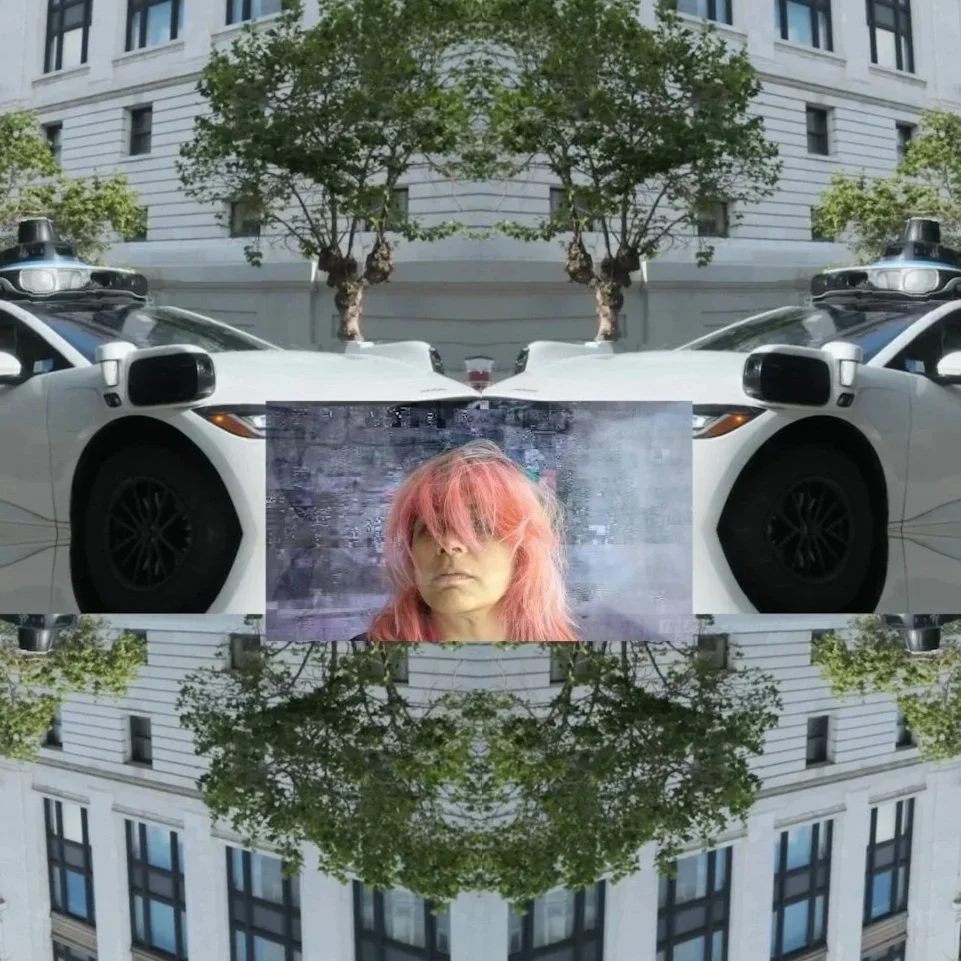
Still from video
The 7 Trillion Dollar Seance
Video piece with original score by Jeromey Cooks (rikuwru), Sound effects by Joe Martin
Premiered: Sept 2025, Tech Together Conference, Siegel Endowment, New York, NY
Published in ASAP/Review's "Algorithms and the Occult" cluster, edited by Tamara Kneese, Ph.D., Jeffrey Moro, Briana Vecchione, Ph.D.
This video art piece reveals how AI culture functions as technological spiritualism — channeling our collective grief and suffering to further concentrate power. The séance metaphor examines how we're made vulnerable to false hope: promises of superintelligence solutions, mind uploading, climate salvation—while actual material violence goes unchecked. This piece is meant to be performed live, which creates space for audiences to process collective grief together rather than in the isolation of digital spectacle.
Image by Giovana Fleck
Data Narratives Civic Media Observatory
Partnership with Global Voices: Asteris Masouras – Coordinating Editor, Georgia Popplewell – Narratives Editor, Giovana Fleck – Project Lead, Ivan Sigal – CMO Methodology Designer, Samanta Azpurua – Coordinating Editor, Şerife Wong – Project Strategist and Analyst, Tim Davies – Technical Lead, Digital Rights Lab – Sudan, Abigail Paz – El Salvador, Alice Lana – Brazil, Sencer Odabasi – Turkey, Shubhangi Heda – India
Supported by: Omidyar Future of Data Challenge winner
Launched: Dec 2024
Governments, tech companies, and civil society all have competing visions for how data should be managed. This project documents the competing narratives about data in El Salvador, Brazil, Turkey, Sudan, and India. We also examine artificial intelligence specifically, since AI narratives are particularly powerful: they often frame these systems as inevitable tools for progress, even as they're deployed for surveillance and controlling populations. Understanding whose interests are served by different ways of talking about data and AI is essential for anyone trying to shape better policy.
Logo treatment by Kristen Sunde
Artificial Life COACH
Site Design Kristen Sunde, research assistant Hannah Cornejo
Supported by: Mozilla Foundation Creative Award Recipient
Launched: May 2024
Artificial Life Coach is a life coach that coaches computers not people via psychic connection. Parodying commercial spirituality, the piece deflates AI hype to replace it with critical thinking. This performance art takes place on social media and promotes an understanding of AI’s limits and connects them to a bigger picture of power and inequality. Similar to how magicians like Harry Houdini debunked psychics, the piece posits many tools marketed as AI as also something that is made up of our faith and parlor tricks. The companion website presents a collection of resources curated to cater to audience interest and learning styles. These include artworks, videos, books, people to follow, and research-based essays that raise questions and provide critical re-imaginings of AI.

Close up of illumination
Origin of Clouds
Published by: Logic(s) Issue 19 supa dupa skies (move slowly and heal things)
Print: June 2023
In this Illuminated essay, Wong compares her experience using a generative AI art tool to Islamic art practices. It reveals how the excitement around generative AI tools help obfuscate how they concentrate power and strengthen the status quo. It is a political and philosophical piece that explores the formal boundaries of art: research and tech ethics as art, painting as performance art, and pushing what contexts an artist can make art in as a form of social sculpture. The text is carefully hand-written with a fountain pen with any mistakes needing a complete revision of the page. The commitment to hand labor, thematic at first, became a meditation that is not an escapist practice from the news cycle, but rather, one that cultivates more alertness toward the stakes. The artist considers this piece as context-dependent. To situate the work, read other essays from Logic(s). This piece is dedicated to Abdurehim Heyit, a master Uyghur folk poet musician who was detained in 2017 by the Chinese Government in the ongoing Xinxiang-based Uyghur genocide.

Image by Eryk Salvaggio
LutteCoin: Situationist blockchain
Art and research led with Eryk Salvaggio
Partners: Excavations: Governance Archaeology for the Future of the Internet, University of Colorado Boulder and King’s College London With support from the Eutopia Foundation and in collaboration with DiploFoundation.
Launched: December 2021 at the United Nations Internet Governance Forum
LutteCoin is cryptocurrency imagined as a project of The Situationist International, the 1960s social movement made of avant-garde artists and political theorists inspired by surrealism, Dada, and libertarian Marxism. Just as Bitcoin relies on Proof-of-Work protocol we invent the “Proof of Non-Work Consensus Protocol” to turn devices into an otherwise useless object, or “brick.” Users, liberated from the spectacle of electronic interfaces, pursue other dreams. The devices mine currency, become inaccessible, and eventually, burn out; in a parody of economics.

Site design by Lusion
Fairer Tomorrow: Solutions to the Issues Highlighted by COVID
Site Design with Lusion
Partner: Center for Advanced Study in the Behavioral Sciences (CASBS) at Stanford University
Launched: February 2021
This immersive website experience features more than 100 specific ideas, observations, recommendations, and solutions advanced by members of the moral political economy program network. Upon entering the site, visitors encounter a space where they can drag and move their cursors through an animated field containing points of light; each one representing an idea. Clicking a point of light reveals a quote often read by the authors themselves.
Background image for project courtesy of artist Francis Ruyter
Fluxus Landscape: An Expansive View of AI Ethics and Governance
Research led with Aparna Ashok
Partners: Center for Advanced Study in the Behavioral Sciences (CASBS) at Stanford University
With support from The Stanford Institute for Human-Centered Artificial Intelligence (HAI)
Launched: June 2019
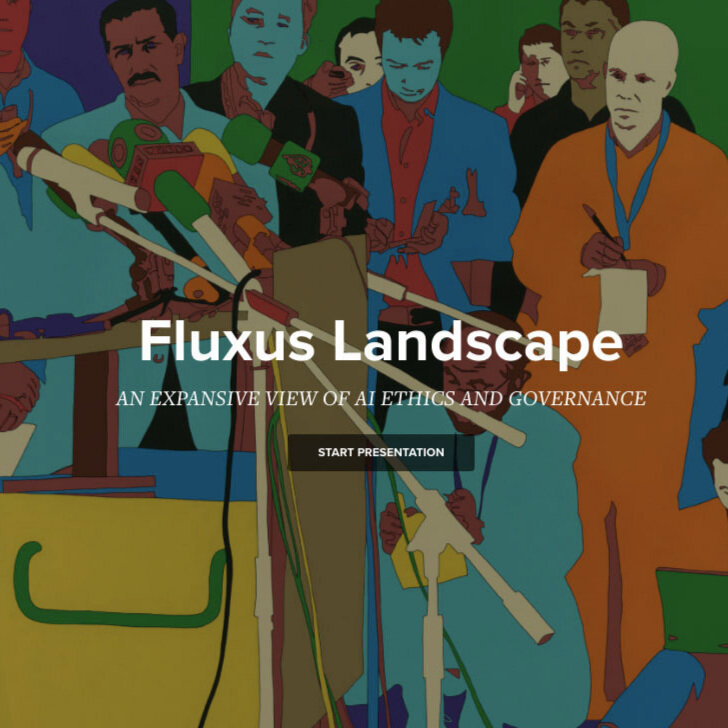
Art and research project created in partnership with the Center for Advanced Study in the Behavioral Sciences (CASBS) at Stanford University with support from The Stanford Institute for Human-Centered Artificial Intelligence (HAI). The project maps and categorizes about 500 AI ethics and governance stakeholders and actors. Its goals are both practical and artistic: to help the global community interested in AI ethics and governance discover new organizations, and encourage a broader, more nuanced perspective on the AI ethics and governance landscape.
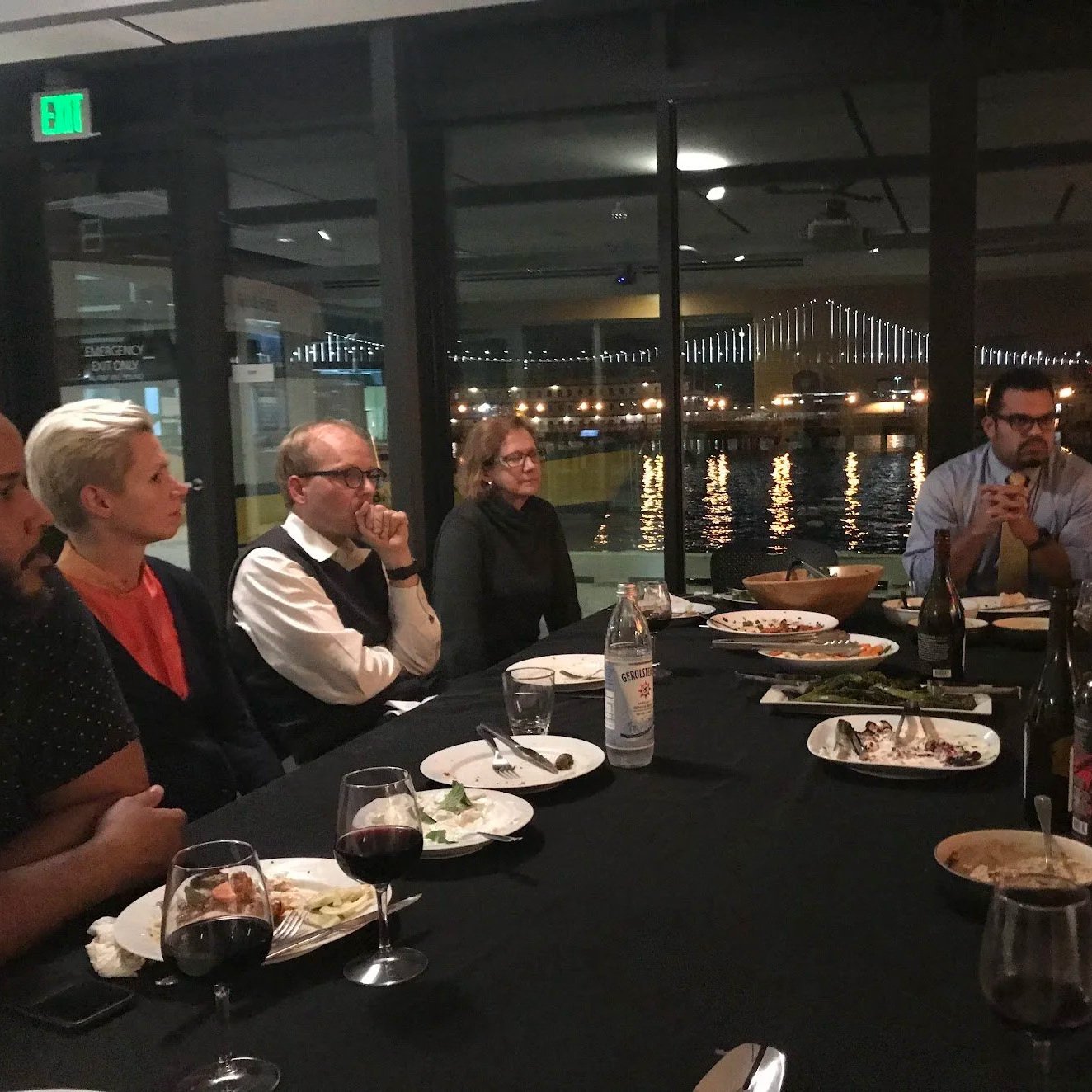
AI ethics dinner at Pier 9, Nov 2017
The Dinner Salon for Ethics and Technology
Partners: Autodesk Pier 9 Workshop
Launched: May 2017
A series of evolving dinner salons that incorporate broader perspectives, whether economic, societal, or psychological, that are meant to trigger insight into some of the most challenging problems of emerging technology through a curated experience.